
A dedicated developer adds capacity from the first sprint when three things are in place: a concrete brief, an onboarding plan for the first month, and clear terms on who employs the developer and who owns the code. Without them, even a strong developer takes months to become useful.
In our experience of placing dedicated developers, the pattern is consistent. The engagements that go well are not the ones with the most impressive CVs. They are the ones where the client knew what the developer would work on in week one.
What a dedicated developer is, and what it is not
A dedicated developer works only on your project, full-time or part-time, inside your tools and process. You set the priorities; the provider handles employment, payroll, equipment and replacement.
It is different from a fixed-price project, where the provider owns delivery of a defined scope, and from a freelancer, who usually works for several clients at once. Dedicated developers suit ongoing product work with a roadmap that changes month to month.
Write the brief before you look at a single CV
Vague briefs like "full-stack help" lead to slow starts. A good brief fits on one page:
- Stack and versions. "React 18 with Next.js and a Node.js API", not "JavaScript".
- Seniority. Can they make architecture decisions alone, or will they follow an existing lead?
- Time-zone overlap. How many hours a day must they be online with your team?
- The first two tickets. Real tasks from your backlog they will own in the first weeks.
- Who reviews their work. Name the person who reviews their pull requests.
Interview for delivery, not trivia
Puzzles test how someone performs in interviews. They tell you little about how that person ships. Instead:
- Walk through one of your real tickets and ask how they would approach it.
- Ask about a production problem they fixed, and what they changed afterwards.
- If speed matters, use a short task on a copy of your codebase.
You should interview every candidate yourself, even when a provider has screened them. At Xcrino, clients get a shortlist within 72 hours and interview everyone before anyone starts.
Plan the first month, not just the first day
Most of the ramp-up time is lost to access requests and unclear priorities. Before day one, prepare:
- Access to the repositories, ticket board, chat channels and staging environment.
- A short note on how code moves from branch to production.
- The meetings they join, and who they ask when they are stuck.
- A definition of done for week one: usually one small change merged and deployed.
A developer who ships a small fix in the first week settles in far faster than one who spends that week reading documentation.
Keep employment and IP clear in writing
Before day one, the contract should state who employs the developer, who owns the code, how confidential information is handled, and how knowledge is handed back if the engagement ends. At Xcrino, all code and IP transfer to the client on full payment, and we sign an NDA on request.
What does a dedicated developer cost?
Rates depend on stack, seniority, time-zone overlap and how long you need the developer. As a reference, a full-time dedicated developer from Xcrino starts from $800 (about ₹72,000) a month, and a dedicated AI or ML developer from $1,250 (about ₹1.13 lakh) a month. Part-time, hourly and team options are also available. See our hire developers page for each stack.
Red flags when choosing a provider
- They won't let you interview the actual developer.
- The developer turns out to be a freelancer subcontracted by the provider.
- There is no replacement promise if the fit is wrong.
- Code ownership is vague, or tied to anything other than payment.
- You can't start with a short trial or a one-month term.
Not sure you should build custom software at all? Read custom software vs SaaS. Hiring for AI work? See how to build an AI agent for what the team will need to deliver.
What engagement models can you hire dedicated developers on?
Most providers offer a few models. At Xcrino the options are:
- Full-time: a developer working 160 hours a month on your product.
- Part-time: a developer working 80 hours a month, suited to smaller scopes or maintenance.
- Hourly (time and material): you pay for hours used, which fits uncertain or changing scope.
- Team with a project manager: several developers with a PM, for larger builds that need coordination.
Dedicated developers start from $800 a month (about ₹72,000) for non-AI stacks and from $1,250 a month (about ₹1.13 lakh) for AI and ML developers, with a one-month minimum. A one-week risk-free trial lets you check the fit before you commit. See our hire a developer page and the AI and ML developers page for details.
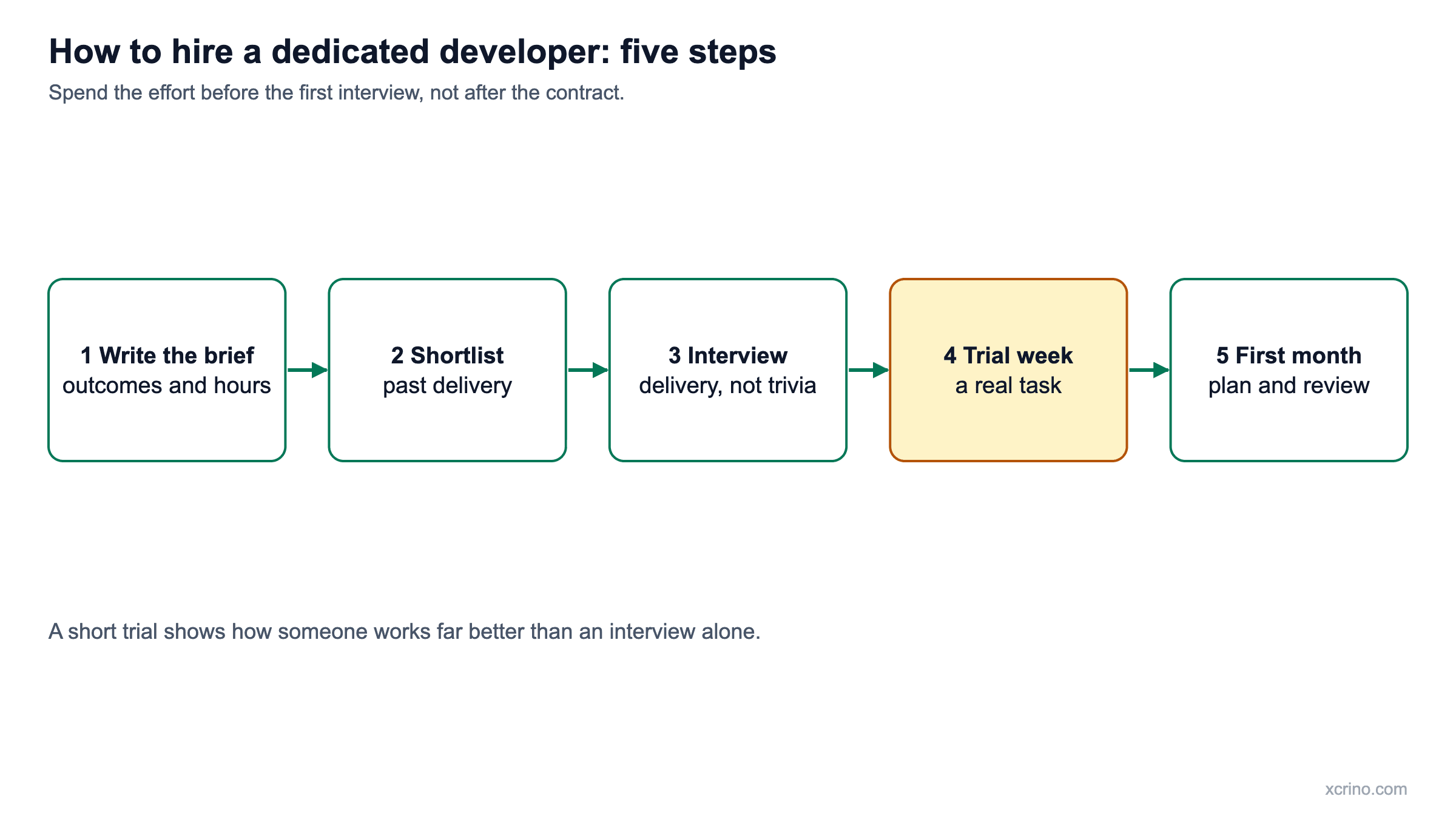
The diagram below shows the five steps we suggest, with the trial week highlighted.
How do you vet a dedicated developer? A checklist
- Delivery history: shipped products in your stack, and a person who can describe what went wrong as well as right.
- A real task: a short paid or trial task on your codebase beats a quiz.
- Communication: can they explain a trade-off in plain language and ask a good question about your brief?
- Code review: read a sample of their code, or have your engineer pair with them for an hour.
- Working hours: agree the overlap with your team before you start.
- References: speak to someone who has managed them.
What does a good first 30 days look like?
- Week 1: access and context. Accounts, repositories, a walkthrough of the product, and one small task shipped.
- Week 2: ownership. A defined area of the code, with a reviewer and a standing check-in.
- Week 3: delivery rhythm. Estimates, daily updates and the first feature merged.
- Week 4: review. Compare what was delivered with the brief, adjust the scope and decide how to continue.
Should you hire freelancers, an agency or build in-house?
- Freelancers are quick to start and flexible, but you manage everything and continuity is a risk.
- A dedicated team from an agency gives you ready capacity, replacement cover and a project manager, at a steady monthly cost.
- In-house hires give the deepest context and control, but recruiting takes months and fixed costs continue when work slows.
Many teams start with dedicated developers to move quickly, and hire in-house once the product and the roadmap are stable. If you are hiring for AI work, see how to build an AI agent for what the team will need to deliver.
What are the hidden costs when hiring developers?
- Your own management time, especially in the first month.
- Tools, licences and cloud accounts the developer needs.
- Rework when the brief was unclear.
- Knowledge that leaves with the person if code and documentation are not kept.
- Overlap hours: a mismatch in working hours slows reviews and decisions.
At Xcrino, source code and IP transfer to you on full payment, and we sign an NDA whenever you ask.
Questions we are often asked
How long does it take to hire a dedicated developer?
With a clear brief, a shortlist can arrive within days. At Xcrino it is within 72 hours, and most developers start within a week of the brief being agreed.
Is there a trial period?
It depends on the provider. Xcrino starts every engagement with a 1-week risk-free trial and a one-month minimum term.
Should we hire one developer or a team?
Start with one developer when you have an existing team and a clear backlog. Hire a small team with a project manager when you are building something new and don't have someone in-house to run delivery.