
An AI agent is software that completes a multi-step task for you: it plans the steps, uses tools in your other systems, checks its own results and asks a person to approve anything risky. This guide explains what AI agents do for a business, how they differ from chatbots, how to test and build one, what it costs and who you need, with links to a detailed guide on each step.
What is an AI agent for business?
A business AI agent takes a goal such as "refund this duplicate charge" and works through it: look up the order, check the policy, ask for approval if needed, process the refund and send a confirmation. A chatbot, by contrast, answers questions. If you are not sure which you need, read AI agent vs chatbot, which compares them with diagrams and a worked example.
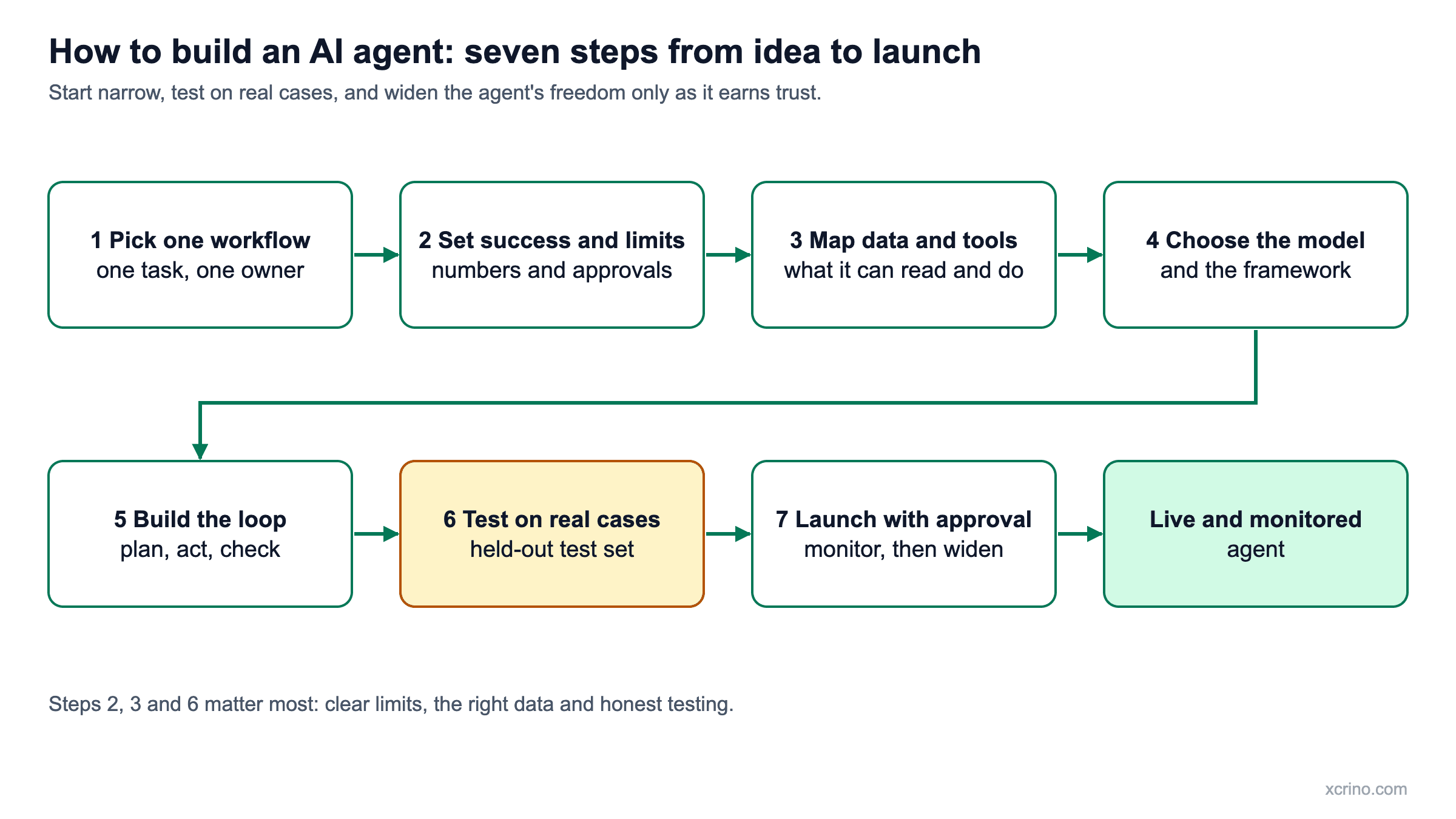
The diagram below shows the seven steps of building an agent, covered in detail in our build guide.
Where do AI agents fit, and where do they not?
Agents suit work that follows rules but needs judgement at each step, across more than one system: support requests, lead qualification, invoice checks and reporting. They are a poor fit for tasks that must be exact every time with no review, or where a simple rule already works. Our guide to where AI belongs in a product gives a quick test.
How do you adopt an AI agent, step by step?
- Decide. Pick one workflow and confirm an agent, not a chatbot or a rule, is the right tool. Start with AI agent vs chatbot.
- Give it knowledge. If the agent must answer from your documents, add retrieval. Read what RAG is and RAG vs fine-tuning.
- Test cheaply. Run a fixed-price proof of concept on your real data. See how to run an AI proof of concept.
- Budget properly. Quote the build and the running cost separately. See how much an AI agent costs.
- Build it safely. Plan, act, check, with limits, approvals and tests. See how to build an AI agent.
- Staff it. Decide whether to build with your own team or dedicated developers. See hiring dedicated developers and custom software vs SaaS.
What does an AI agent cost?
At Xcrino, a fixed-price AI proof of concept starts from $3,000 (about ₹2.7 lakh) and usually takes 2–4 weeks. A first production release typically takes 1–2 months and starts from $5,000 (about ₹4.5 lakh). Dedicated AI and ML developers start from $1,250 a month. Running costs such as model usage and monitoring are quoted separately.
Why do some AI agent projects fail?
Gartner predicted in June 2025 that over 40% of agentic AI projects will be canceled by the end of 2027 because of escalating costs, unclear business value or inadequate risk controls. The answer in each case is the same: a narrow workflow, success measures in numbers, a proof of concept before a build, and approvals from day one.
What can AI agents do in each part of a business?
- Customer support: look up orders, apply policies, draft replies and process simple requests with approval.
- Sales and marketing: qualify leads, enrich CRM records, draft outreach and schedule follow-ups.
- Finance: check invoices against orders and flag mismatches for review.
- Operations: watch stock or tickets and raise requests to the right team.
- Reporting: pull figures from several systems and prepare a summary for a person to review.
Is your business ready for an AI agent? A checklist
- The workflow is repeated often and takes real staff time.
- It spans more than one system, or needs a lookup and a decision.
- There is a clear right answer a person could check.
- The data the agent needs is available and reasonably clean.
- Someone owns the process and can review the agent's work.
- You can name the numbers that would make it a success.
If most boxes are ticked, a proof of concept is the right next step. If few are, start by fixing the data or the process, or consider a chatbot instead.
Glossary: the terms you will meet
- AI agent: software that plans and carries out a multi-step task using tools, within limits.
- Agentic AI: the broader term for AI systems that act towards a goal; in business use it mostly means the same as AI agents.
- Tool: an action the agent may take, such as a database lookup, an email or an API call.
- RAG (retrieval-augmented generation): looking up passages in your own content before writing an answer, usually with sources.
- Fine-tuning: training a model further on examples so it behaves more consistently.
- Guardrails: limits and approval steps that stop an agent acting beyond what you allow.
- Proof of concept: a short, fixed-scope test of one use case on your real data.
Where can you see this work in practice?
See our AI agent development, RAG development and AI proof of concept services, and our demand forecasting case study for a machine-learning project that reached production.
Questions we are often asked
What is an AI agent in simple terms?
Software that carries out a task for you across several steps and systems, checking its own work and asking a person before risky actions.
Is an AI agent the same as a chatbot?
No. A chatbot answers questions in a conversation. An AI agent completes tasks. See AI agent vs chatbot.
How long does it take to build an AI agent?
A proof of concept usually takes 2–4 weeks and a first production release 1–2 months at Xcrino, depending on data, integrations and risk.
Do AI agents need my data?
They need access to the data and systems the task involves. Start with read-only access, add write access one action at a time, and agree where data is stored and processed before the build.
Are AI agents safe for customer-facing work?
They can be, within limits: approvals for costly actions, logging of every step, and testing on real cases before launch.
Where should a small business start?
With one narrow, frequent workflow and a small proof of concept. A small, well-tested agent is worth more than a broad one nobody trusts.