
Short answer: use retrieval-augmented generation (RAG) when the AI must answer from your own documents and data, and that content changes. Use fine-tuning when you need the model to behave in a consistent way, such as a fixed format, tone or specialised task. Many business solutions combine both: RAG for knowledge, fine-tuning for behaviour.
What is RAG?
RAG is a way of building AI assistants that first look up relevant passages in your own sources, such as policies, manuals, product data or support tickets, and then write an answer from what they found, usually with citations. The model itself is not changed. When your documents change, you update the index, not the model.
What is fine-tuning?
Fine-tuning trains an existing model further on examples of the inputs and outputs you want. It changes how the model behaves: the format it writes in, the terms it uses, or how it handles a narrow task. It does not reliably teach the model new facts that change often.
When should a business choose RAG?
- Answers must reflect current, company-specific information.
- Users need to see where an answer came from.
- Content changes weekly or monthly.
- You want to start quickly and keep costs predictable.
When should a business choose fine-tuning?
- You need a consistent output format, such as structured data extraction.
- The task is narrow and repeated at high volume.
- Prompting alone does not give reliable enough behaviour.
- You have enough good examples of the right output to train on.
How do RAG and fine-tuning compare?
- Keeps knowledge up to date: RAG yes; fine-tuning no, it needs retraining.
- Shows sources: RAG yes; fine-tuning no.
- Changes style and format: RAG partly, through prompts; fine-tuning yes.
- Time to first result: RAG usually faster; fine-tuning slower, because it needs training data.
- Best for: RAG suits knowledge assistants, support and document Q&A; fine-tuning suits consistent extraction, classification and specialised tasks.
Can you combine RAG and fine-tuning?
Yes, and many production systems do. A common pattern is RAG to supply accurate, current knowledge, plus a lightly fine-tuned or carefully prompted model to answer in the right format. We usually start with RAG and good prompting, measure the results, and fine-tune only if the measurements show it is needed.
How Xcrino decides for clients
We start with a fixed-price AI proof of concept from $3,000 (about ₹2.7 lakh), built on your real content and tested against real questions. Our founder and AI lead reviews whether your data can support the approach before the build starts. If the proof of concept works, a first production release typically takes 1–2 months from $5,000 (about ₹4.5 lakh). Read more about our RAG development services.
New to the topic? Start with our plain-English guide to what RAG is, and see how RAG fits alongside agents in AI agent vs chatbot.
How do you decide between RAG and fine-tuning? A four-question test
Answer these in order and stop at the first result that fits. The diagram below shows the same test.
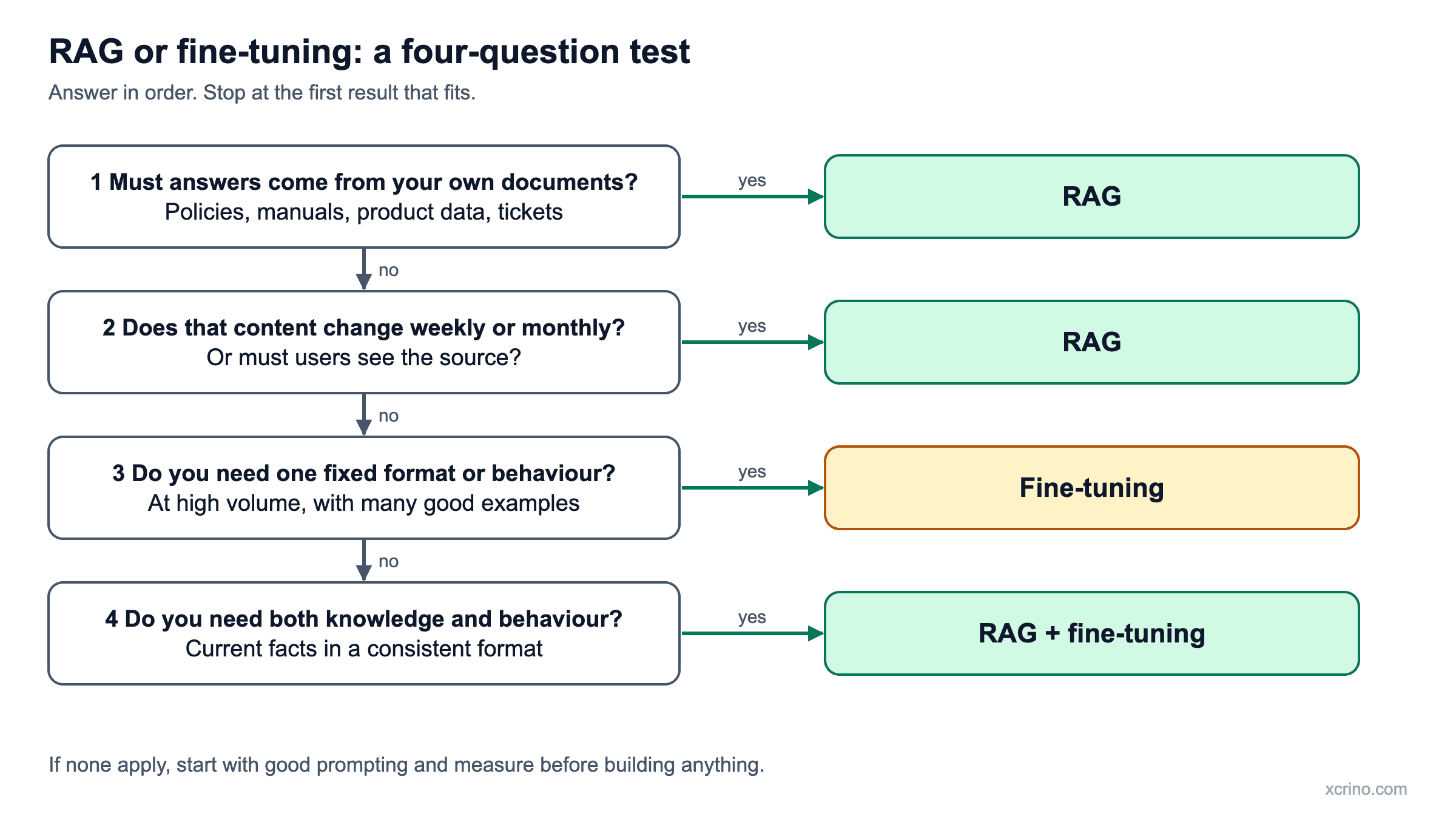
- Must answers come from your own documents? If yes, use RAG.
- Does that content change weekly or monthly, or must users see the source? If yes, use RAG.
- Do you need one fixed format or behaviour at high volume, with many good examples? If yes, consider fine-tuning.
- Do you need current knowledge in a consistent format? If yes, combine both.
If none of these apply, start with careful prompting and measure the result before building anything.
What do the research and vendor guidance say?
Retrieval-augmented generation comes from a 2020 research paper by Lewis and colleagues, which combined a pre-trained language model with a searchable index of documents. The authors showed that the index can be replaced to update what the system knows as facts change, without retraining the model. That is the core reason RAG suits content that changes.
Vendor guidance points the same way. Microsoft's guidance for Azure OpenAI says to start with RAG when you want to add knowledge from outside the model's own domain, and to measure a base model with prompt engineering or RAG before fine-tuning. OpenAI's guide to optimizing accuracy warns against treating prompting, RAG and fine-tuning as one straight path, and suggests judging how much a failure costs you and how much a success earns before choosing.
Worked example 1: a support assistant (RAG)
A support team wants answers drawn from its help centre, refund policy and product sheets, which change every few weeks. The assistant retrieves the relevant passages, answers from them and links the source, so an agent can check it. When the refund policy changes, the team updates the document and the index, and the assistant answers correctly the same day. Fine-tuning would freeze the old policy into the model and need retraining.
Worked example 2: invoice field extraction (fine-tuning)
A finance team receives thousands of invoices a month in a handful of layouts and needs the same fields in the same structure every time. The task is narrow, repeated at volume and judged on format. With many examples of correct output, a fine-tuned model can be more consistent than prompting alone. We would still measure a prompted baseline first and fine-tune only if the numbers show a gap.
How long does each take, and what does it cost?
RAG projects at Xcrino start with a fixed-price AI proof of concept from $3,000 (about ₹2.7 lakh), usually 2–4 weeks, built on your real content and tested on real questions. A first production release typically takes 1–2 months and starts from $5,000 (about ₹4.5 lakh). Fine-tuning adds work before any of that: collecting and cleaning good examples, training, and testing against a baseline. Ask any vendor for a measured baseline before agreeing to fine-tune.
Common mistakes when choosing
- Fine-tuning to add facts. It changes behaviour, not what the model reliably knows.
- Launching RAG without a test set. Without real questions with known answers, nobody can tell if a change helped.
- Skipping the prompt baseline. Good prompting sometimes solves the problem more cheaply than either method.
- Ignoring access control. A RAG assistant should only answer from documents each user may see.
For the full picture of how RAG works, read our guide to what RAG is. If you plan to give the assistant tools to act, see how to build an AI agent.
Part of our series on AI agents: see AI agents for business: the complete guide for how RAG, agents and proofs of concept fit together.
Questions we are often asked
Is RAG cheaper than fine-tuning?
RAG is usually faster and cheaper to start, and easier to keep up to date, because you update the index and not the model. The final cost depends on the number and format of your sources and the integrations needed.
Can fine-tuning teach a model new facts?
Not reliably. Fine-tuning mainly changes how a model behaves, such as its format and terms. For knowledge that changes, RAG is the safer choice.
Does RAG need a vector database?
RAG needs a searchable index of your content. It often uses meaning-based (vector) search combined with keyword search, and the right setup depends on your content.
How long does it take to build a RAG assistant?
A fixed-price proof of concept usually takes 2–4 weeks. A first production release typically takes 1–2 months.
Do I have to choose between RAG and fine-tuning?
No. Many systems combine them. We usually start with RAG and good prompting, measure the results, and fine-tune only if the measurements show it is needed.
Is RAG safe for private documents?
It can be, with access control so users only get answers from documents they are allowed to see. We agree where data is stored and processed before the build starts.