

An AI proof of concept (PoC) is a short, fixed-scope build that tests whether AI can solve one specific business problem with your real data. It ends with working software, measured results and a clear go or no-go decision. Done well, it replaces opinions with numbers for a small, fixed cost.
When should you run a proof of concept?
Run one when you have a specific problem in mind but are not sure AI will solve it well enough with your data. Skip it when the answer is already obvious, such as a standard chatbot on a public FAQ, or when you have no data yet. In that case, start by collecting the data you will need.
How to run an AI proof of concept in six steps
1. Pick one narrow use case
"Use AI in customer support" is too broad. "Draft replies to order-status emails" is a use case. The best proofs of concept are narrow, measurable and close to real work: document extraction, a knowledge assistant, a support agent, demand forecasting, lead or risk scoring, or classifying and routing tickets.
2. Agree success criteria before building
Decide what "good enough" means in numbers before anyone writes code: accuracy, time saved per task, and the running cost you can accept. Without this, every result can be argued either way.
3. Check the data first
Look at a real sample. Is there enough of it, is it clean, and does it represent the cases you care about? Missing fields, inconsistent labels and too little history show up quickly, and it is far cheaper to find them in week one than after a full build.
4. Build the thinnest working version
One workflow, one data source, and a fallback for when the model is unsure. Keep a person in the loop wherever a mistake would be costly. The aim is evidence, not a polished product.
5. Measure on data the model has not seen
Hold back part of your data as a test set and measure accuracy, speed and expected running costs against the criteria from step 2. A demo that works on hand-picked examples proves very little.
6. Decide: go, change scope, or stop
A clear no-go is a good outcome. It means you spent a small, fixed amount to avoid a much larger build that would not have worked. A go comes with a plan for production.
What should a good proof of concept deliver?
- A working prototype running on your real data.
- Measured accuracy, speed and expected running costs, compared with your success criteria.
- A clear go or no-go recommendation.
- If it is a go, a scoped plan and a fixed quote for production.
What does an AI proof of concept cost?
At Xcrino, a fixed-price AI proof of concept starts from $3,000 (about ₹2.7 lakh) and usually takes 2–4 weeks. If the result is a go, a first production release typically takes 1–2 months and starts from $5,000 (about ₹4.5 lakh). INR figures are approximate, at about ₹90 to the US dollar.
Our founder and AI lead, Dr Sunil Gupta, reviews your data before the build starts. Source code and assets transfer to you on full payment, and we sign an NDA whenever you ask.
Why do proofs of concept fail?
- The use case is too broad. Nothing can be measured, so nothing can be decided.
- There are no success criteria. Every result becomes a matter of opinion.
- The data is not representative. The model works on the sample and fails on real cases.
- It is judged on a demo. Results are not measured on data the model has not seen.
- Running cost is ignored. A model that is accurate but too expensive to run is still a no-go.
For help deciding which problems are worth testing at all, read where AI belongs in a product. For an example of a use case that reached production, see our demand forecasting case study.
Testing an AI agent idea? Read AI agent vs chatbot first to decide whether your use case needs an agent or a simpler assistant before you scope the proof of concept.
Once the proof of concept is a go, our guide on how to build an AI agent explains the steps from workflow to launch.
A week-by-week plan for a four-week proof of concept
A proof of concept can finish sooner, but this is how four weeks typically divide. The diagram below shows the same plan.
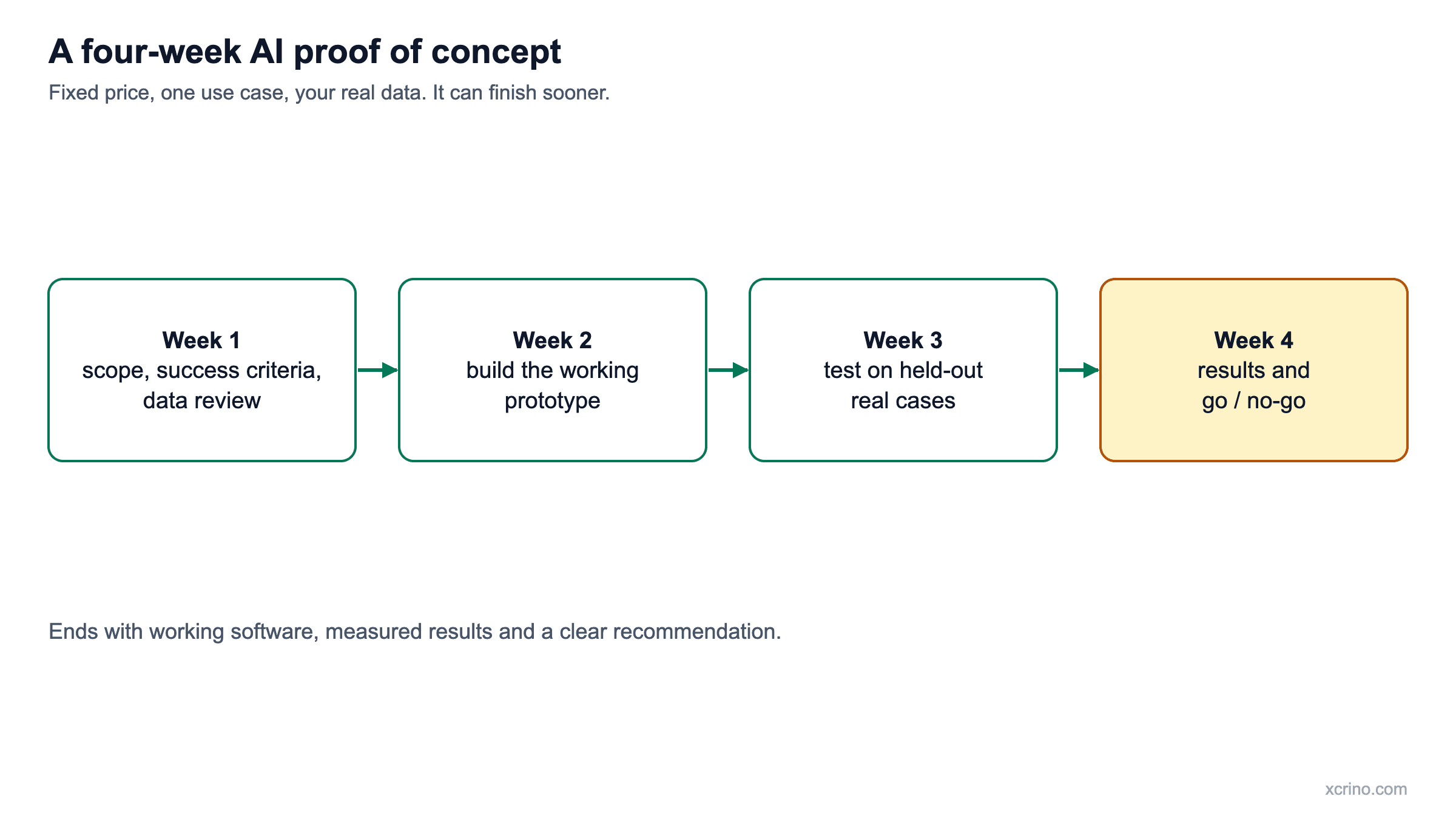
- Week 1: scope and data. Agree the one use case, write the success criteria, and review whether your data can support it.
- Week 2: build. A working prototype on your real data, with the simplest design that can be measured.
- Week 3: test. Run it on cases it has not seen, and measure accuracy, speed and expected running cost.
- Week 4: decide. Present the numbers and a clear go, change-scope or stop recommendation.
A template for success criteria
Fill in each line with a number before the build starts:
- The agent must complete ___ % of cases correctly without help.
- It must hand over to a person in no more than ___ % of cases.
- Each task must take no more than ___ seconds.
- Each task must cost no more than ___ to run.
- Wrong actions must stay below ___ per 1,000 tasks.
Why does a proof of concept protect your budget?
Gartner predicted in June 2025 that over 40% of agentic AI projects will be canceled by the end of 2027 because of escalating costs, unclear business value or inadequate risk controls. A fixed-price proof of concept addresses each: the cost is capped, the value is measured on your data, and risk controls are tested before real systems are touched.
What should you bring on day one?
- A one-paragraph description of the workflow and who does it today.
- A sample of real data, anonymised where needed.
- Access to the systems the prototype will read from.
- A person who knows the right answers and can review results.
- The success measures from the template above.
How do you read the results?
- Go: the numbers meet the criteria. Move to a first production release, typically 1–2 months from $5,000 (about ₹4.5 lakh) at Xcrino.
- Change scope: the numbers are close. Narrow the task, improve the data, or add an approval step, and test again.
- Stop: the numbers are far off and the data cannot support the task. You spent a small, fixed amount to learn that.
If the result is a go, our guide on how to build an AI agent covers the next steps, and how much an AI agent costs explains what drives the price of a larger build.
A proof of concept is step three of adopting an AI agent. See AI agents for business: the complete guide for all the steps.
Questions we are often asked
How long does an AI proof of concept take?
Usually 2–4 weeks, depending on how ready your data is and how many systems the prototype must connect to.
How much data do we need?
It depends on the approach. A RAG assistant needs your documents. A forecasting model needs enough clean history. A short data review at the start tells you whether you have enough before the build begins.
What happens if the proof of concept shows AI will not work?
You have spent a small, fixed amount to find out, and you have measured results to base your next decision on.
What happens if the result is a go?
We give you a scoped plan and a fixed quote for a production release, which typically takes 1–2 months. You decide whether to go ahead.