

AI belongs in a product where it reduces the time to an answer or a decision on messy inputs: documents, free text, images or patterns too complex for rules. It does not belong where a filter, a template or a checklist would do the job, or where the result must be exactly right every time with no human review.
That is the test we apply in every project. We look for where AI can help the business, and build it in only where the data supports it. In practice, that means saying "not here" quite often.
Good fits for AI
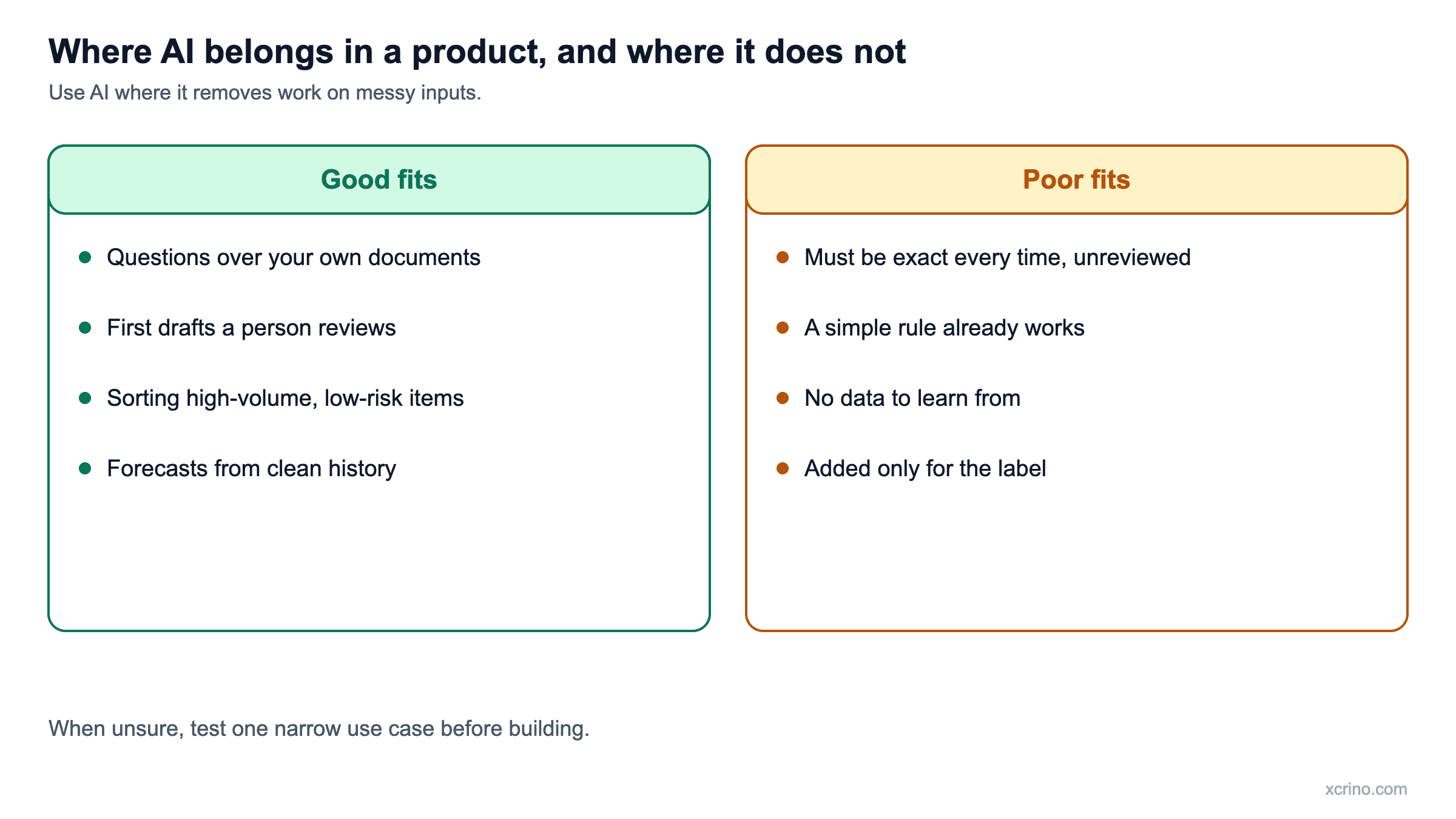
- Search and Q&A over your own content. Manuals, policies, tickets and contracts, answered with sources shown so people can check. This is what RAG development is for.
- First drafts that a person reviews. Replies to customers, summaries of long documents, product descriptions.
- Classifying high-volume, low-risk items. Routing tickets, tagging documents, sorting leads, where you can measure accuracy.
- Forecasting from history. Demand, stock and churn, when you have enough clean past data.
- Multi-step tasks across your tools. An AI agent that gathers information, fills in a system and asks a person to approve. See AI agent development.
Poor fits for AI
- Anything that must be exactly right every time with no review. Invoices, access control, clinical dosing or contract figures should stay deterministic until you have testing and audit trails that match the risk.
- Problems a rule solves. If you can write the logic as "if X then Y", write it. It is cheaper, faster and easier to explain.
- Decisions without data. A model can't learn a pattern your data doesn't contain.
- Features added only for the label. An AI chatbot that answers worse than your FAQ page damages trust.
Agents, RAG or machine learning: a quick guide
- RAG when people need answers from your documents and data, with sources.
- An AI agent when a task takes several steps across systems and a person approves the result.
- Classic machine learning when you need a number or a category from structured data: a forecast, a score, a risk level.
- Fine-tuning rarely as a first step. It changes how a model writes, not what it knows. We explain this in RAG vs fine-tuning.
Ship a thin slice first
Pick one workflow, one data source and one measure of success, and build a fallback for when the model is unsure. Run it with real users. Expand only after that slice is trusted in production.
A fixed-price AI proof of concept is the cheapest way to do this. At Xcrino it costs from $3,000 (about ₹2.7 lakh) and takes 2–4 weeks, and you get a clear go or no-go answer at the end. Before any build starts, our founder and AI lead reviews whether your data can support the model.
What a working AI feature looks like
Our work for a Tokyo character-goods brand is a good example. The brand needed to know which products would sell. We built a demand-forecasting model in Python with scikit-learn and XGBoost, trained on sales history, product attributes, seasonality and web data. It runs inside the client's own system and helped lift online sales revenue by 20–35% year on year. Read the demand forecasting case study.
If you are deciding between an AI agent and a chatbot, our guide to AI agent vs chatbot explains the difference with diagrams and a worked example.
Deciding whether to build or buy? Our guide to custom software vs SaaS shows when each one wins.
Five questions to ask before adding AI
- Is the input messy? Documents, free text and images suit AI. Clean, structured inputs often suit a rule.
- Can a person check the result? If not, can the cost of an error be tolerated?
- Do we have data? A model cannot learn a pattern your data does not contain.
- Can we measure success in numbers? Accuracy, time saved, cost per task.
- Would a simpler tool do? A filter, a template or a checklist is cheaper and easier to explain.
The diagram below shows the good fits and poor fits side by side.
Examples by team
- Support: draft replies from the help centre for an agent to approve (a good fit); issuing refunds with no review (a poor fit until tested).
- Finance: matching invoices to orders and flagging mismatches (a good fit); calculating tax liability unreviewed (a poor fit).
- Sales: scoring leads from past outcomes (a good fit when you have clean history); promising prices to customers (a poor fit).
- Operations: forecasting stock from sales history (a good fit); safety-critical controls (a poor fit without strict testing).
What is "agent washing", and how do you avoid it?
Gartner uses the term for vendors that relabel chatbots, assistants or robotic process automation as agentic AI without real autonomy. In its June 2025 analysis it estimated that only about 130 of the thousands of agentic AI vendors are real. Ask any vendor whether the product can finish a multi-step task across more than one system on its own, shows its steps, and stops when it is unsure. Our guide to AI agent vs chatbot explains the difference.
What does a failed AI feature look like?
- A chatbot that answers worse than the help page it replaced, so users stop trusting it.
- A model trained on too little or inconsistent data that looks good in a demo and fails on real cases.
- A feature added to a product for the label, with no measure of whether it helps anyone.
The cheapest protection is to test one narrow use case before building. Our guide to running an AI proof of concept shows how, and what RAG is covers the most common first use case.
If agents look like a fit, AI agents for business: the complete guide walks through what they do and how to adopt one.
Questions we are often asked
How do we know if our data is good enough for AI?
Start with a small test on a real sample. Most problems show up quickly: missing fields, inconsistent labels, too little history. A proof of concept answers this before you commit to a full build.
Will AI replace our team?
In our projects, AI usually removes repetitive steps such as searching, copying and first drafts, so people spend more time on decisions. Every system we build keeps a person in the loop where mistakes are costly.
How much does it cost to add AI to a product?
A proof of concept starts from $3,000 (about ₹2.7 lakh). A first production release typically starts from $5,000 (about ₹4.5 lakh) and takes 1–2 months, depending on data, integrations and risk.